
30-60-90
product strategy &
product operating model
This page outlines a sample 30-60-90 day plan to establish a winning product strategy and product operating model.
What makes a good product strategy?
A strategy is not a plan, it is a framework for decision making. A good product strategy tells us two important things: 1) what customer problems are we solving? and 2) how are we solving them in a way that is different from everyone else? It also helps us to understand what we’re not doing, and gives us permission to focus. A good product strategy also connects to a larger organizational strategy, ideally via a structured goal-setting framework like OKRs.
A great product strategy also evolves through periodic evaluation and feedback.
What makes a good product operating model?
Great product and engineering teams use near-scientific approaches to learn about and deliver customer value: hypotheses, measurement, experimentation, feedback, and controls. The two key activities of a product team are discovery (figure out what problems customers need solved) and delivery (ship features meant to address those problems). A great operating model enables discovery and delivery to evolve together in a mutually beneficial cycle.
A team is also composed of people, and the right operating model for a specific team will take into account the strengths of the individuals and the organization as a whole. The operating model also serves the organization and the leaders of the organization by bridging key strategic gaps: knowledge, alignment, and effects.
So, how do we get there?
First 30 days
Meet people, create a stakeholder registry, and assess the interest and impact of all players on product strategy decisions, and product operating model decisions. Leaders and executives will need to see their own priorities and needs reflected. Product Managers and Designers on the team will need to see their strengths and preferences accounted for.
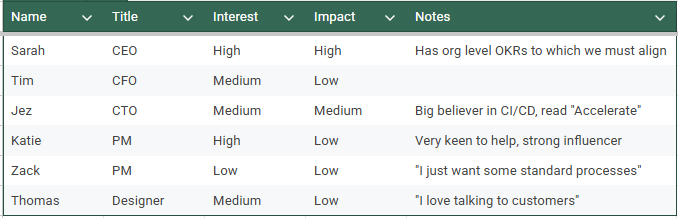
Product strategy must align with the overall organizational strategy, and so it will be important to find and organize any existing organizational strategies (e.g. OKRs, pivots, top priorities, big goals) and determine what if any measures exist.
Product strategy must also take into account our market direction and opportunities, and our existing customer insights, and so it will be important to find and organize any existing customer interviews, market analyses, and other customer relationship data including establishing relationships with sales, customer success, and other customer-facing functions.
I don’t believe in any ONE right approach to a product operating model, and I see limited success when operating models are imposed or parachuted onto a team. However, the value of a standardized product operating model is undeniable and there ARE good practices and bad practices in product management.
Therefore, the first 30 days will include observation and conversations with leaders, executives, engineers, stakeholders in other departments (e.g. sales, marketing, and customer success), and of course with the product management team itself. The goal in the first 30 days is to identify existing operating modes, preferences, needs, and pain points.
At the end of the first 30 days it will be possible to say how the product strategy and product operating models need to evolve. A summary report along the lines of a SWOT will help to communicate findings and elicit feedback from all stakeholders.
By 60 days
In the next 30 days we will begin to implement changes.
The current product strategy will be outlined in a formal document, and published internally for transparency. Ideally, this can take the form of a strategy framework (akin to Melissa Perri’s approach described in “Escaping the Build Trap”) or OKRs (as described by John Doerr in “Measure What Matters”) provided that these frameworks align well with the organizations existing models, or given enough internal support.
It is critical to communicate the temporary nature of this document. It is NOT the product strategy. It is a current state only, and subject to change. Indeed, it sets the tone for change. It demonstrates through action that product strategy is not fixed but rather evolvable through review and debate.
This review and debate will take place throughout this second phase, with stakeholder groups meeting regularly for short sessions to debate priorities, add information, and make their cases for raising or lowering priority on each strategic objective.
The product operating model will likewise be formalized in a short, simple document that describes the teams current standard operating procedures as well as the processes and methods that vary by team or by PM. The goal is not to immediately force everyone into the same box, but rather to give space to different styles where needed, standardize where possible, and move towards good practices.
PMs, Designers, and others (self nominated) will participate in a book club to read “Continuous Discovery Habits” by Teresa Torres. This book describes one of the best product management frameworks available to both new and seasoned PMs, along with superb tools like the Opportunity Solution Tree and the Customer Interview Snapshot to help organize all the information pouring into our team. We read this book because it inspires PMs and Designers with it’s approach and helps to organize a difficult and chaotic work space into a well-organized and easy to grasp mental model.
The product operating model will adopt 2-3 tools from Continuous Discovery that are most exciting to the team, as a way to gain some easy wins and build momentum towards larger change.
By 90 days
By the beginning of the third month, we have established a good understanding of the current state, and held several reviews and debates about the product strategy. We have a formalized document that is ready to be modified, improved, and approved.
Our review and debate sessions will conclude with the formalization of a new product strategy document. All key decision makers have been identified by this point, and it will be their responsibility to meet and approve the strategy. Again, this document is temporary, but it’s timeline is now longer - it will guide product decisions for the next quarter, 6 months, or even year (as appropriate for our market). This document should be simple, easy to read, short, and transparent to everyone at our organization.
Our new product strategy will tells us, quite simply, what customer problems our products are meant to solve and how we solve them in ways that differentiate us from the competition.
Our product operating model will likewise be a relatively simple, short, easy to read document that is available to all stakeholders internally. It will describe the standard operating procedures of the product team at the current moment and the expectations that we have for ourselves, and that others can have of us.
The operating model will focus on how we interact with customers to gain insights into their problems, how we formulate hypotheses about features that will help them, and how we develop, deliver, and measure the success of those features. My preference is that we iterate the product operating model towards something resembling Torres’ Continuous Discovery process, but not all aspects of this approach may be appropriate for the team. There may also be beloved processes, procedures, and rituals that work well and should not be changed. There is no ONE right way to build products, and experimentation will lead us to the mix of tools and techniques that work best for us.
By the end of the first 90 days, we will have a formal document outlining the way we work right now. But this will be constantly evolving in small ways, towards something better.